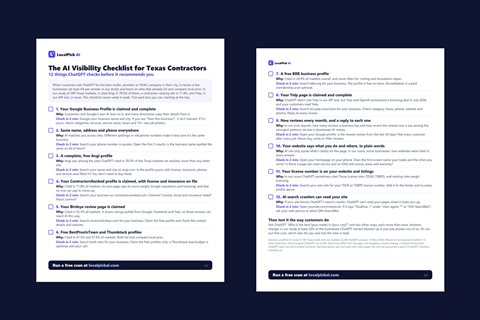
Before paying for a listing or a review campaign, ask which claim the evidence actually supports. Guidance about Google Maps does not automatically explain a ChatGPT answer. A directory appearing in one saved response does not establish a universal requirement.
Use this guide to separate documented facts, observations from your own tests and ideas that still need checking. The practical checklist is our recommendation for organizing that work. It is not a claim that every listed action improves AI recommendations.
What Google says about Business Profiles
Google describes local results using relevance, distance and prominence. Its guidance includes accurate business information and explains that reviews and links contribute to prominence. These are statements about Google's local results. Google's local-ranking documentation is the source.
For its AI features, Google says the established SEO fundamentals still apply and recommends keeping Business Profile information current. It does not prescribe special AI markup as a requirement for those features. Google's AI-features documentation explains this guidance.
The practical implication is limited but useful: maintain your profile as part of your Google presence. Do not turn those statements into a guarantee that a profile edit will cause ChatGPT to mention you.
For your own audit, record the profile URL and the details you checked. Keep the real-world business information beside it so discrepancies are easy to review.
Use the Google Business Profile maintenance guide to turn confirmed profile gaps into a work list.
What the review guidance actually establishes
Google allows businesses to request reviews and prohibits incentives for posting, changing or removing them. Its guidance also recommends professional, relevant replies. Google's review documentation gives those rules.
That supports an honest feedback process. It does not provide a ChatGPT review-count target or a schedule that guarantees inclusion in an answer. Do not describe a vendor's proposed target as an official requirement unless the vendor can provide a source that actually says so.
Our recommendation is to ask for genuine feedback and keep review management accountable to customer service. Have the business owner approve replies to sensitive complaints. Avoid publishing personal job details or using a public response to argue about a customer's private circumstances.
When measuring the work, record what you actually did: requests made through your approved process, replies reviewed and profile inaccuracies corrected. Keep those operational records separate from AI test results.
What a directory citation can tell you
If a saved answer links to a directory, you can inspect the linked page and record its contents. Check whether it discusses your business, a competitor or a general service category. Save the exact URL rather than just the directory's domain.
OpenAI's web-search API distinguishes inline citations from its fuller consulted-source list. That supports careful labeling; it does not identify a universal directory checklist for local companies. OpenAI's source documentation explains the distinction.
Use "cited in this answer" for a visible link. If your report contains a consulted-source export, name that field separately. If you only have a screenshot, do not claim to know the full source history.
You can then ask whether the page is accurate and whether a correction is possible. That is a concrete task. "Buy this directory listing to get recommended" requires different evidence that this guide does not provide.
For a public source-inspection example, review the questions, date and cited pages on the Dallas HVAC market page.
Keep an evidence ledger
Create a short record before deciding what to fix. Use categories that prevent a guess from becoming a fact:
| Category | Example of suitable wording |
|---|---|
| Official guidance | Google recommends accurate Business Profile information; link the relevant documentation |
| Observed result | This saved answer cited this exact directory page |
| Verified error | The inspected page lists a service the owner confirms is no longer offered |
| Proposed action | Ask the page owner to correct that description |
| Unresolved explanation | It is not established whether that error affected the recommendation |
The example is a worksheet pattern, not a report of an actual business. Replace it with your own evidence and preserve the links.
Give each observation a date. If a page changes during the review, keep a note of the earlier wording and when you saw it. Do not silently replace historical evidence with the current version.
Audit the profile details that customers need
We recommend checking your name, website, main contact details, service area and current hours first. Compare the profile with your approved business records. Resolve differences with the owner before making edits.
Google requires businesses to represent themselves accurately, including their real-world name and precise address or service area. Its rules also address business categories and unnecessary additions to the name. Google's representation guidelines are the reference.
Treat an uncertain service claim as a question for the team. Does the business really offer emergency service? Does it accept commercial work? Is a listed town within the current operating area? Do not expand the description merely to match a test prompt.
Save an edit log with the old value, approved replacement, responsible person and verification date. This makes the maintenance work reviewable even if the next AI answer does not change.
Prioritize directory work from observed problems
Begin with an incorrect page you can identify or a source that appears in your saved test. Confirm that it refers to the right company. Check for a duplicate listing before asking for a change.
Use the site's published correction process. Keep "requested" and "verified" as different statuses. If the site gives no correction route, record the limitation instead of marking the problem solved.
For a paid offer, ask what is included: listing control, a fixed sponsorship, reporting or another service. Ask which part of the fee buys which deliverable. Request support for any claim about AI placement before treating it as evidence.
Do not assume a large directory count means the work is complete. For this audit, completion means the named problems were checked and the approved corrections were verified. Keep a separate list of sites you considered but did not need to change.
Review the website as another source of business facts
Compare your own service and contact pages with the approved profile information. We recommend explaining actual services in ordinary language and linking to the page a customer needs to take the next step.
LocalBusiness structured data can communicate details such as hours and departments to Google. It is a way to describe business information, not proof of a ChatGPT placement benefit. Google's LocalBusiness documentation describes its use.
Ask your developer to review whether the markup matches the visible page. Do not put claims in structured data that you would not stand behind in the customer-facing description.
After a repair, check the public page and retain the result in your ledger. Keep website, profile and directory edits identifiable so you can explain exactly what changed.
If your audit finds an incorrect phone number or hours, our business-information correction guide provides a focused next step.
FAQ
Does a good Google profile guarantee an AI recommendation?
No guarantee is supported by the guidance cited here. Use it to maintain accurate information and evaluate your saved answers separately.
How many reviews do I need for ChatGPT?
The official sources cited here do not establish a threshold. Ask anyone selling a specific target to provide evidence for that specific claim.
Should I join every directory I find?
Our recommendation is to start with verified gaps and relevant evidence. Evaluate other listings on their actual purpose and terms.
How do I know whether an edit helped?
Repeat your defined test and report what changed. A later mention alone does not establish which edit caused it.
Check your business
Source documentation checked November 11, 2026. The audit steps above are our recommendations.
Run a free scan at localpickai.com to check your ChatGPT visibility and build a fix list from the findings.