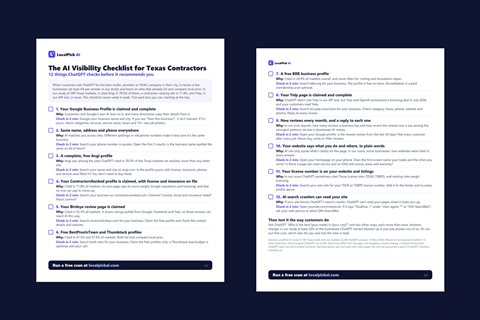
Before adding AI visibility to a marketing plan, define the result you want to inspect. Do you want to know whether a page can be found in search, whether a business is suggested in an answer, or whether an inquiry led to work? Keep those questions separate.
For this guide, use "SEO" for work on your website's search presence and "AI visibility" for observing how a named AI product represents your business in a defined set of answers. These are working definitions for planning, not a universal measurement standard.
You can use both without buying into a promise that one replaces the other. Start with useful work, explicit evidence and a clear explanation of what the report measures.
If the terminology is new, start with what AI visibility means for a local business.
What the official guidance says about overlap
Google says its established SEO practices remain relevant to AI Overviews and AI Mode. It does not require a special AI file or a separate schema type for inclusion in those features. Google's AI-features guidance supports that point.
This is a statement about Google's products. Do not treat it as documentation for every AI system. Keep the name of the product beside any claim about requirements or measurement.
Our practical recommendation is to review the same business facts across your website, profiles and reports. A contractor should be able to approve the service description once and identify where it needs updating. That is an information-management choice, not a promised ranking effect.
Separate access from selection
For Google Search, basic eligibility includes an accessible page, a successful response and indexable content. Google says meeting the requirements does not guarantee indexing. Google's technical documentation explains those conditions.
For ChatGPT search, OpenAI identifies OAI-SearchBot as the search crawler and distinguishes its controls from GPTBot's training role. OpenAI's crawler documentation is the reference for that distinction.
Ask the person managing your site to document the relevant access checks. If a problem is found, record exactly which system was affected, what changed and how the fix was verified. Avoid a report that simply says "ready for AI" without showing the work.
Treat access as a specific technical question. Keep a recommendation outcome in your test record instead of assuming that allowing a crawler determines the answer.
Compare the questions each report answers
Build the report around observable evidence:
| Question | Evidence to request |
|---|---|
| Can this service page be accessed and indexed? | The relevant technical check and its date |
| Did the business appear for this search? | The saved search observation and conditions |
| Did an AI answer recommend the business? | Exact prompt, answer, product and collection date |
| Did an answer cite the business's website? | The linked page and citation in that answer |
| Did marketing produce an inquiry or job? | The client's attribution and sales records |
These are proposed reporting categories. Do not substitute one for another because the numbers look better. A cited page and a recommended provider should be labeled separately. A business inquiry needs its own supporting record.
Keep unknown outcomes unknown. If the client cannot identify where an inquiry came from, do not assign it to AI visibility to complete the table.
Use useful content as a shared work item
Review a real service page with the person who provides that service. Ask whether it explains the work, the area covered and how the customer should proceed. Make a list of unclear or unsupported statements before expanding the page.
Google encourages content created for people and informed by firsthand expertise. Its helpful-content guidance supports that editorial principle. It does not establish that adding a particular paragraph will cause a ChatGPT recommendation.
For a roofer, our suggested review might focus on the difference between repair and replacement estimates. For a plumber, it might clarify the kinds of jobs accepted. For an HVAC company, it might explain the actual installation assessment process. Use your own operations to decide what belongs on the page.
Keep claims supportable. Do not invent certifications, service coverage, response times or project outcomes to make the business fit a desired query. Have the owner approve substantive business claims before publication.
For help writing those explanations, see our service-page and FAQ guide.
Avoid turning local coverage into page volume
If you serve another town, decide what information a customer there actually needs. Start with your genuine operating area and any relevant service limitations. Do not create a location claim that the business cannot fulfill.
Google's spam policies cover doorway abuse and scaled content created primarily to manipulate rankings without helping users. Google's spam-policy documentation gives the relevant rules.
Our recommendation is to evaluate a proposed page on its purpose and evidence. Can you explain why it exists? Can the team verify its claims? Does it provide something useful beyond a changed town name? If not, revise the plan before multiplying the pages.
Keep page creation and AI test results separate in the work log. Publishing more pages is an activity count; it does not by itself demonstrate a better recommendation outcome.
Add a repeatable AI check
Choose a service, city and product. Save a small set of discovery questions that do not supply your own company name. Ask for current sources, and record the answer with its links. ChatGPT's web-search feature can show citations when used. OpenAI's web-search documentation describes the feature.
For your method, record the date, visible model label and context supplied. Preserve unsuccessful or unusable requests separately. Keep all completed answers instead of selecting the most favorable one.
On the next review, use the same questions and document any changed conditions. Report how often the business was named within that saved sample. Avoid calling the figure a share of all local searches or an estimate of missed revenue.
Use direct questions about your company in a separate accuracy check. Compare statements about its services and contact details with owner-approved information.
Browse the Dallas market pages for examples of dated, trade-specific observations. Keep their scope separate from your website's search and inquiry reports.
Choose work with a clear acceptance condition
Start with a verified problem and define what completion looks like. A task might be to correct a service-area statement on a named profile or repair an inaccessible service page. Give it an owner and a review date.
Ask an agency to show the old state, the change and the verification. For monitoring work, ask for the prompt set, completed-answer count and evidence links. For content work, ask which customer questions the revised page answers.
Do not approve an open-ended package based only on a new acronym. Request deliverables you can inspect and a clear account of which results remain outside the provider's control.
FAQ
Should I stop SEO and switch to AI visibility?
Review your actual business results and maintenance needs first. This guide recommends adding a defined observation process, not abandoning useful existing work based on a label.
Can one agency handle both?
Yes, if it can explain the scope, evidence and deliverables for each. Ask to see a sample report with real definitions and clearly marked limitations.
What is a sensible first step?
Save a baseline for one important service area, inspect the evidence and choose a factual repair. Expand the work when you have a concrete reason.
Check your business
Source documentation checked November 11, 2026. The audit steps above are our recommendations.
Run a free scan at localpickai.com to see whether ChatGPT recommends your business and use the findings alongside your existing SEO work.