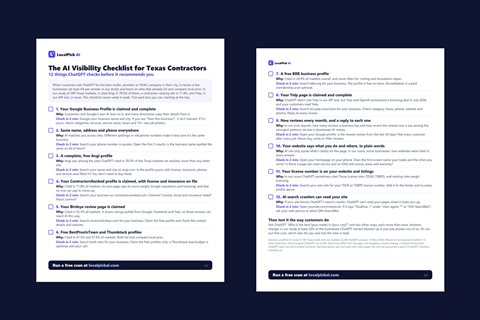
You've probably seen the phrase "AI visibility" in an ad or an email from a marketing company. It sounds technical, but the idea is simple: when someone asks an AI tool for a local business like yours, does your business get named?
This guide explains what AI visibility is, what it measures, how it differs from the Google rankings you may already know, and how to check your own. It stays practical and honest about what's known. AI visibility is a new field, the research is mostly observational, and nobody can guarantee a result.
The definition
AI visibility is how often, and how prominently, AI tools name your business when people ask for local recommendations, and whether what they say about you is correct.
That breaks into three questions:
- Are you named? Out of the times an AI tool answers "Who's the best plumber in Plano?", how many answers include you?
- How prominently? Are you first on the list or fifth? Are you described accurately?
- What did it read? Which websites did the AI use to decide? Those sources are what you can actually influence.
We measure the first one as simply as possible: "named in X of N answers." If we ask a question six times and you appear in two, that's 2 of 6.
How it differs from Google rankings
Traditional local SEO is about position: you're number 3 in the map pack, or number 7 in the search results. AI tools work differently. They give one written answer, usually naming a handful of businesses, and often cite a few sources.
The gap can be large. SOCi's 2026 study of 350,000+ business locations found that ChatGPT recommended about 1.2% of them, Perplexity 7.4% and Gemini 11%, while 35.9% appeared in Google's local 3-pack (SOCi, via NatLawReview). Those are mostly multi-location brands and SOCi sells reputation software, but the direction is clear: being on Google's map doesn't mean being named by an AI tool.
So in practice:
| Google local results | AI answers | |
|---|---|---|
| What you get | A list of many businesses, ranked | One written answer naming a few |
| Where you stand | A position (1, 2, 3 …) | Named or not named, and how often |
| Same every time? | Fairly stable for a given searcher | Often changes from run to run |
| What it reads | Your Google profile, site, reviews, links | A mix of directories, "best of" sites, your site, your profile |
What it looks like in our data
We read the public snapshots behind our Who AI Recommends pages: 390 Texas markets (a trade in a city) and 2,238 ChatGPT answers from November 10, 2026.
- ChatGPT usually had a favorite per question: the top business appeared in about 87% of answers on average.
- But on average only 1.4 businesses per market were named in at least five of six answers. The rest of the list rotated.
- ChatGPT's citations went mostly to ranking sites and marketplaces (Angi in 78.5% of markets, ContractorsRanked in 71.8%). It cited Yelp and Facebook in none.
That is one AI tool, one day and Texas only. It's a snapshot, not a verdict.
What goes into it
Researchers and vendors have found several things that tend to go with being named. These are patterns, not proven causes:
- Being listed and accurate on the sites AI reads. For home services these are often directories, "best of" lists and marketplaces. See the directories ChatGPT reads.
- Review count and freshness. In one 2026 study, ChatGPT named about 1 in 5 businesses whose newest review was under a week old, and fewer than 1 in 50 when the newest was a year old (Revfer, observational). See how many reviews and how recent.
- A website AI can read. OpenAI says sites that block its search crawler won't appear in ChatGPT search answers. See OAI-SearchBot.
- Correct basic facts. Name, address, phone and hours that match everywhere.
What we can't say is that any one of these makes an AI tool name you. Be wary of anyone who says otherwise.
How to check yours
You can measure AI visibility yourself with a notepad:
- Write three questions customers ask ("Who is the best [trade] in [city]?").
- Ask each one two or three times, in a fresh chat each time.
- Count how many answers name you, and record the websites cited.
- Repeat monthly.
The full steps are in the five-minute test. Our free scan does this for you and adds a check of your website.
What AI visibility is not
- Not a ranking. There's no "position 1" you can hold. Answers vary.
- Not traffic. Being named doesn't tell you how many customers saw it or called. See how to track visits and calls from ChatGPT.
- Not a replacement for Google. Most homeowners still use search and word of mouth; a 2026 roofing survey found 74% follow a recommendation from a neighbor or family member (Roofing Contractor). See will ChatGPT replace Google.
- Not guaranteed by anyone. OpenAI itself says top placement can't be guaranteed.
Why bother
Because the work overlaps with things that help you anyway: accurate listings, fresh reviews, a clear website. If AI becomes a bigger source of customers, you'll be ready. If it doesn't, you've still tidied up the places customers check before they call.
FAQ
Is AI visibility the same as SEO? They overlap, but they aren't the same. SEO is mainly about position in search results. AI visibility is about being named in written answers, from a different mix of sources.
Do I need special software to measure it? No. A notepad and a few repeated questions work. Software saves time and runs more questions.
How long does it take to improve? Unknown. Some fixes take effect in a day or two; others depend on when sources update. Measure monthly.
See your AI visibility today. Run a free scan at localpickai.com. You'll see whether ChatGPT names you, who it names instead, which websites it read, and what to fix first. Free, no signup, about a minute.