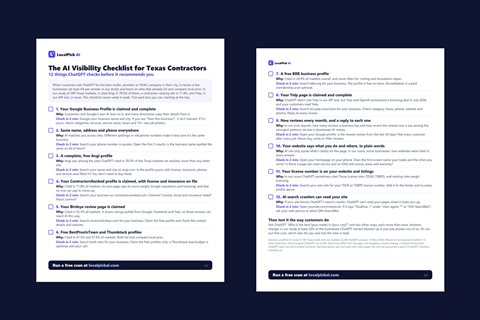
Marketing has a way of inventing new initials every time something changes. First SEO, then local SEO. Now you hear GEO, AEO, AI SEO, LLMO and "AI visibility." If you run a roofing, plumbing or HVAC company, you may reasonably wonder: is any of this new, or is it SEO with a new coat of paint?
This guide defines the terms in plain English, explains what's genuinely different, and tells you what to do. The short version: the labels are mostly marketing, a few things are new, and the foundations haven't changed much.
The terms
| Term | Stands for | What people usually mean |
|---|---|---|
| SEO | Search engine optimization | Improving your position in regular search results |
| Local SEO | Local search engine optimization | Improving your position in Google Maps and local results |
| GEO | Generative engine optimization | Getting named or cited by generative AI tools |
| AEO | Answer engine optimization | Getting chosen as the answer by AI answers, assistants and featured snippets |
| AI SEO | AI search optimization | A catch-all for the above |
| LLMO | Large language model optimization | Same idea, aimed at models like ChatGPT |
| AI visibility | n/a | How often AI tools name you; a measurement more than a tactic. See what is AI visibility |
In practice, vendors use these interchangeably. Two businesses selling "GEO" and "AEO" may be selling nearly the same service.
Where the idea comes from
"Generative engine optimization" was introduced in a 2023 research paper that tested ways of changing website content to appear more in AI-generated answers. It reported visibility gains of up to 40% in its benchmark, with results varying by topic and tactic (arXiv). That study looked at general web questions, not local contractors, so it doesn't tell a plumber what to do. But it popularized the term.
What's actually new
A few things are genuinely different from traditional SEO:
- The output is an answer, not a list. An AI tool names a handful of businesses in a written reply. You're named or you aren't.
- The sources are different. For home services, ChatGPT's citations in our Texas study went mostly to ranking sites and marketplaces, not Google's map pack. We saw Angi in 78.5% of 390 markets and ContractorsRanked in 71.8%, with Yelp and Facebook in none. See the "best of" sites.
- Different tools use different sources. Google's AI Mode cited Google properties 95.5% of the time in one study, while ChatGPT cited Google 0.1% (Cheers). See Google AI Overviews vs AI Mode vs ChatGPT.
- Answers vary run to run. You measure "named in X of N answers," not a position. See why ChatGPT gives different answers.
- There's a new technical gate. If your site blocks OpenAI's search crawler, ChatGPT search can't show it. See how to allow OAI-SearchBot.
What isn't new
Much of the work is what good local marketing always was:
- An accurate, complete Google Business Profile.
- Consistent name, address and phone everywhere.
- Fresh, honest reviews.
- A clear website with a page for each service and the cities you serve.
- Credentials (licenses, insurance, certifications) that are easy to verify.
- Listings on the directories customers use.
Google itself says there's nothing special to do for its AI features beyond the basics: "There are no additional requirements to appear in AI Overviews or AI Mode, nor other special optimizations necessary" (Google).
What doesn't hold up
- "Special markup is the key." A test of 1,885 pages found no clear effect of schema on ChatGPT citations. See schema markup and llms.txt.
- "We can guarantee you'll be recommended." OpenAI says top placement can't be guaranteed, and no vendor controls it. We never guarantee rankings or recommendations either.
- "This replaces SEO." Most homeowners still ask people they know and use search. A 2026 roofing survey found 74% follow a recommendation from a neighbor, friend or family member, and half use search engines (Roofing Contractor). See will ChatGPT replace Google.
- Big percentages with no source. For example, "22% of homeowners go to ChatGPT first." We couldn't find a published sample size or method for that number.
A plain-language translation
If someone pitches you "GEO" or "AEO," try translating it: "We'll check what AI tools say about your business, fix the places they read, and report monthly." If the pitch can be boiled down to that, the acronym is just a label, and you can judge the offer on the work, the price and the honesty of the promises. If it can't, ask them to explain in plain words what they'll do.
What a contractor should do
You don't need to learn the vocabulary. You need a short list:
- Check where you stand, by asking AI tools the questions customers ask, several times. See the five-minute test.
- Fix the basics, in this order: crawler access, your Google profile, the directories AI cites for your trade, reviews, your service pages.
- Re-check monthly and keep a log.
- Keep doing normal marketing, because AI is one channel among several.
Questions to ask a provider who uses these words
- "What specifically will you do, and how is that different from what a normal local SEO company does?"
- "How will I know if it's working, and over what period?"
- "What do you guarantee?" (If the answer is a ranking or recommendation, walk away.)
See how to hire an AI-visibility agency for a full list.
FAQ
Is GEO better than SEO? They aren't competitors. They overlap heavily. Good local SEO is a solid base for AI visibility.
Do I need an "AEO specialist"? Not necessarily. The tasks are mostly listings, reviews and a clear website, which many local marketers and you can do.
Which term should I search for? Any. "AI visibility," "GEO," "AEO" all point to the same set of tasks.
Skip the jargon. Run a free scan at localpickai.com. You'll see whether ChatGPT names you, who it names instead, which websites it read, and what to fix first. Free, no signup, about a minute.