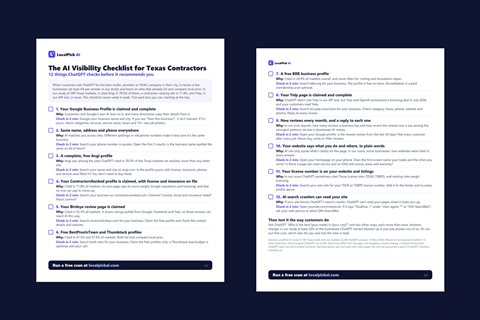
When checking an AI answer about your HVAC company, start with the evidence attached to that answer. Do not begin with a universal list of directories you supposedly need to join. The question you need to answer is narrower: which pages are cited here, what do they say, and are they accurate?
ChatGPT can use web search and show citations. Those links give you an inspection starting point. OpenAI's web-search documentation describes this capability. They do not justify assuming that a particular directory caused a business to be selected.
This guide offers a source-audit workflow for HVAC owners. It makes no claim that every answer reads the same websites or follows a published local ranking formula.
Start with the service, not the acronym
Choose a real customer need. For example, test air-conditioning repair, furnace maintenance or heat-pump installation separately. Include a city your team actually serves. Keep commercial and residential work distinct if your offerings differ.
Before testing, write down what an accurate answer should say about your business. Include your service area, working hours, equipment scope and the website page that supports each detail. Treat this as your reference sheet, not text to feed into every discovery prompt.
Try a question such as: "Search current sources for companies that install heat pumps in [city]. Show the sources supporting your suggestions." Save the exact prompt. Run a separate question for AC repair instead of asking one broad question to cover everything.
If the result contains no usable local recommendation, record that fact. Do not rewrite the question repeatedly until your own business appears and keep only that version.
The Dallas HVAC market page is a public example of a dated market snapshot. Inspect its questions and linked evidence before comparing it with your own test.
Build a source list from the actual answer
Copy the answer and its links into a working document. Give each linked page a row. Record the page title, website owner, business discussed and factual statements you can confirm.
Use labels that describe your evidence:
| Label | How to use it in your audit |
|---|---|
| Cited page | A link displayed with the saved answer |
| Company page | A cited page on the provider's own website |
| Directory profile | A cited third-party listing for a company |
| Comparison article | A cited article discussing several providers |
| Unverified page | A source you could not inspect |
These are filing categories for your review, not a hierarchy of ranking power. A row should say what you checked, rather than award an authority score you cannot explain.
Keep a source page's advertising or sponsorship disclosure in your notes if one is visible. Do not automatically treat a paid placement as an independent assessment of workmanship.
Separate cited sources from consulted sources
OpenAI documents a fuller consulted-source list for its web-search API, distinct from inline citations. Ask a report provider which of those it exports. Do not label citation links as a complete research history. OpenAI's API source documentation supports this distinction.
For a manual audit, work with the evidence you can actually save. Use wording such as "this answer cited this profile." Avoid "ChatGPT always reads this site" or "this listing made the AI recommend us."
If a vendor provides additional source data, ask for the capture date, query and product used. Keep that dataset separate from a screenshot taken in your own ChatGPT session. You should be able to tell which evidence belongs to which test.
Check HVAC details carefully
For each page about your company, compare its description with your reference sheet. Pay attention to service distinctions that matter to your business. Does it describe installations you offer? Does it confuse a maintenance plan with emergency service? Does it list a branch that has closed?
We recommend asking your service manager to review technical descriptions before you publish corrections. Use plain wording about what the team does, where it works and what the customer should confirm when booking.
Do not add equipment brands, certifications, guarantees or response times simply because a competitor lists them. Include them only when they accurately describe your company and you can support them.
Keep the audit useful to a real customer. A readable explanation of installation consultations is easier for your team to approve than an instruction to "increase HVAC entity relevance." Give every proposed change a specific page and sentence.
Review access to your own website
OpenAI uses OAI-SearchBot for search and provides separate controls for GPTBot training access. Ask your developer to check the applicable search setting and any hosting restrictions. OpenAI's crawler guide explains those roles.
For Google, eligibility also involves access, a working page and indexable content; eligibility alone does not guarantee indexing. Google's technical requirements describe these conditions. Keep a Google access check separate from your ChatGPT observations.
Request a short written result from whoever manages the site: what was checked, what failed, what changed and how the change was verified. Do not accept "AI enabled" as the entire explanation.
Avoid changing crawler rules without understanding the site owner's intent. The useful task is to identify an unintended barrier and review the proposed correction, not to remove every restriction indiscriminately.
Give your developer the OAI-SearchBot access checklist when requesting that review.
Improve pages with real service knowledge
Choose one important service page to review. Ask whether a customer can tell what the service includes, which area it covers and what happens after an inquiry. Have a technician or service manager answer questions that the current page leaves unresolved.
Google recommends useful content with firsthand knowledge. For an HVAC company, our suggestion is to turn genuine service experience into accurate explanations and approved project examples. This is a content recommendation, not evidence that a specific edit will change ChatGPT's answer. Google's helpful-content guidance explains the underlying principle.
A hypothetical heat-pump page review might reveal that the page names the service but never explains the assessment process. The proposed fix would be to describe that actual process. It would not be to invent savings figures or universal suitability claims.
Use our service-page and FAQ guide to turn an approved service explanation into a page customers can use.
Handle directories one at a time
Start with a profile you observed in the saved evidence, or one that contains a customer-facing error. Verify that the profile belongs to your company before requesting a correction. Keep the old details, proposed changes and final public URL together.
We recommend evaluating paid directory offers as business purchases with explicit deliverables. Ask what the listing includes, what can be edited and what evidence supports any visibility claim. This guide provides no evidence that buying a listing earns a ChatGPT recommendation.
After an edit, check the public page. Keep "correction requested" separate from "correction visible." Then retest your original question on your planned review date.
FAQ
Does a citation prove why a company was chosen?
For this audit, treat it as evidence attached to an answer. Do not infer a complete causal explanation from the link alone.
Should I rewrite every service page?
Start with the page tied to your chosen service and a verified gap. Expand the work when your review identifies a clear reason.
What belongs in the next report?
Include the saved questions, named companies, source checks, completed corrections and unresolved issues. Describe the tested scope without promising the next answer.
Check your business
Source documentation checked November 11, 2026. The audit steps above are our recommendations.
Run a free scan at localpickai.com to see whether ChatGPT recommends your HVAC company, who it names instead, and what to fix first.