Add an AI visibility section to a client's report when you can explain what you measured and show the underlying evidence. Start with the business question: does this tool name the client for the services and cities the client wants to study?
Keep the first version modest. Use a defined set of questions, save the answers and connect verified problems to a short work list. Avoid giving the client a large score with no explanation of how it was produced.
This guide proposes a reporting method. The definitions and workflow below are recommendations, not an industry standard or a claim about how an AI system ranks local businesses.
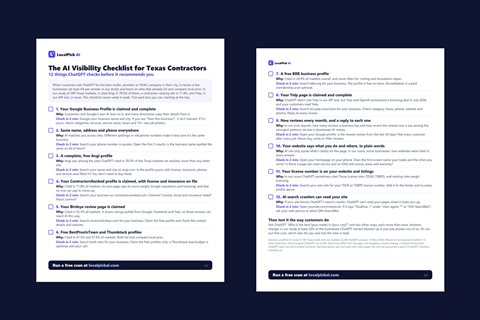
Use the manual recommendation test as a starting checklist when designing the first client sample.
Agree on the scope before collecting answers
Ask the client to approve the services and locations in scope. Separate an HVAC company's repair business from its installation work. Separate a plumber's commercial services from residential jobs if those are different priorities.
Record the exact business name, website and branches included. Decide how to handle trading names and similarly named companies. Keep this reference with the report so a future reviewer can reproduce your decisions.
Choose the product you will test. If you use a monitoring vendor or an API, name that setup accurately. Do not label an API-generated answer as a screenshot from the consumer app. Preserve the model label and relevant settings where the tool exposes them.
Write down how many prompts and repetitions you plan to complete. Treat that as your sampling plan, not an estimate of customer demand.
Build a fixed prompt library
Use plain questions tied to the approved service and city. A suggested pattern is: "Search current sources for companies providing [service] in [city], and show the evidence supporting your suggestions."
Do not insert the client's name into every discovery question. Keep direct questions about the business in a separate accuracy section. Otherwise, the report mixes finding a business with checking a business the prompt already supplied.
OpenAI advises asking for web search and sources when current information needs verification. Its prompting documentation supports that step. Record whether the requested search occurred instead of assuming every completed response used it.
Freeze the prompt wording for the reporting period. If a client adds a new town or service, start a clearly labeled new series and keep the original comparison available.
Save an evidence record for each run
Store the prompt, timestamp, product, visible model label, answer text and links together. Record the supplied location and any relevant context. Give every run an identifier you can reference from the report.
Mark failed requests, empty responses and unusable answers explicitly. Keep them outside the completed-answer denominator and disclose how many were excluded. Do not convert a tool failure into evidence that the client was omitted.
For sources, distinguish what your tool actually provides. OpenAI's API offers a consulted-URL list beyond inline citations. A vendor exporting only citations should not describe them as every page consulted. OpenAI's API documentation explains the difference.
Have someone inspect the evidence behind important findings before they enter the client summary. If that person cannot verify a claim, label it unresolved.
Define useful measures in plain English
Use a small number of measures with visible definitions. For example:
| Measure | Suggested definition |
|---|---|
| Named answers | Completed answers that include the client in the suggested-provider list |
| Named rate | Named answers divided by eligible completed answers |
| Cited client pages | Answers containing a citation to the client's website |
| Verified inaccuracies | Distinct incorrect claims checked against client-approved facts |
| Completed repairs | Work items whose public changes have been verified |
Report the counts behind any rate. Keep service-and-city groups visible rather than combining everything into one figure that hides the scope. Treat a passing mention and a provider recommendation as different labels.
Do not call the named rate market share. In this method, it describes the saved sample of prompts and answers. Do not multiply it by an assumed market size to invent missed leads or revenue.
Write the summary from evidence
Lead with the finding the client can verify. A sentence template is: "For the saved [service] questions in [city], your business appeared in [named answers] of [completed answers]." Replace the fields with real results only.
Then describe accuracy findings and completed work. Link each important statement to its evidence record. Use "the answer cited this page" when that is all the record establishes.
Keep an interpretation section separate. If you suspect an outdated profile may matter, state that as a hypothesis and explain the proposed check. Do not turn a plausible explanation into a confirmed account of why the model chose a competitor.
Avoid making a one-month comparison carry more meaning than the method supports. List changes in prompts, products or collection conditions beside the comparison.
Tie the report to work the agency controls
Choose tasks with a URL, owner, due date and acceptance condition. Examples include correcting an obsolete service area, repairing a broken service page or updating a verified business description.
For technical work, Google documents access, a working page and indexable content as basic eligibility conditions for Search, while noting that indexing is not guaranteed. Google's technical requirements support that check. Keep its scope labeled as Google.
For ChatGPT search access, use OpenAI's OAI-SearchBot documentation. Its training crawler is a separate control. OpenAI's crawler guide is the reference. Record the actual access issue and resolution instead of describing a generic "AI optimization" task.
Close a work item only after checking the public result. A submitted directory correction is still pending until the changed information is visible.
Keep business outcomes in their own section
Put observed visits, inquiries and booked work beside the visibility section only when the client's reporting supports them. State the attribution method and leave unknown sources unknown.
Do not turn a business mention into a booked job. Likewise, do not present the whole organic-search total as traffic caused by AI answers. Ask the reporting owner which sources, reports and filters support the numbers being shown.
If measurement is incomplete, state the gap and the next step to investigate it. A client should be able to distinguish a measured result, a calculated rate and an unresolved attribution question without asking for a second explanation.
For the attribution section, see how to track visits and inquiries from ChatGPT. Keep those records separate from the named-answer rate.
Set expectations for the service
Promise the work you can deliver: a defined test, saved evidence, factual checks and an agreed repair process. Avoid guaranteeing placement or a timetable for a recommendation.
LocalPick AI can support this reporting workflow by checking whether ChatGPT recommends a home-service business, who it names instead, the sites it read and a ranked fix list. Partners also get a branded dashboard: each client's monthly AI report with your logo and colors. A small "Powered by LocalPick AI" footer remains. See the partner program and branded-report details and confirm that presentation with the client before including a sample.
FAQ
Can we add this to an existing SEO report?
Yes. Give it a separate method note and evidence links so the client can understand exactly what the new section measures.
What if nothing changes?
Report that result. Show completed work, unresolved problems and the next review plan without inventing progress.
How should we start?
Choose one client, a defined service area and a small prompt set. Review the evidence before expanding the process.
Check your business
Source documentation checked November 11, 2026. The audit steps above are our recommendations.
Run a free scan for a home-service client at localpickai.com and use the findings to plan the first AI visibility report.