In 2026 OpenAI started selling ads inside ChatGPT, and in May it opened a self-serve tool to US businesses. If you run a roofing, HVAC or plumbing company, you've probably seen agencies pitching it. Is it worth a try?
This guide sets out what's publicly reported about ChatGPT ads, what we don't know, and how a small contractor could test it without betting the business. We're a company that measures organic ChatGPT recommendations, not an ad agency, and we don't sell ads. Most details come from trade-press and agency write-ups, not OpenAI's own documentation, so check OpenAI's official pages before you spend money.
What's been reported
According to coverage of OpenAI's May 5, 2026 announcement (Search Engine Journal, PPC Land) and an agency overview of ads for home services (WebFX, published on KRDO):
- Who can use it: a self-serve Ads Manager in beta for US businesses, with no minimum spend. Earlier pilots had large minimums and ran through agencies.
- Pricing: advertisers can bid per click (CPC) as well as per thousand impressions (CPM). OpenAI reportedly suggested starting CPC bids of about $3 to $5, though that figure comes from secondary sources.
- Targeting: contextual, not keyword-based. You describe the questions and situations your customers bring to ChatGPT, and the system matches ads to those conversations. Geo-targeting was described as still maturing at the country level, so ask how well city-level targeting works. Local services is an eligible category; health, mental health and politics are excluded.
- What an ad looks like: a sponsored card below a relevant answer, labeled as sponsored, with a logo, title, short text and a link.
- Who sees it: users of the Free and Go plans in the US, Canada, Australia and New Zealand. Pro and Business subscribers and users under 18 don't see ads.
- Measurement: a conversion pixel and a Conversions API launched alongside the platform. Advertisers get aggregated results, not chat histories.
What we don't know
- Whether homeowners click. We found no independent results for contractors.
- How well local targeting works for "emergency plumber in Garland" style requests.
- Your cost per booked job. Clicks cost money; jobs make it. The number that matters is cost per booked job, and nobody can tell you yours in advance.
- Whether ads change organic recommendations. Ads are labeled and separate from ChatGPT's normal answers, and nothing we found says paying changes who ChatGPT names organically.
How it compares with other lead sources
For rough context, a roofing SEO price guide puts Google Local Services Ads at roughly $55 to $95 per lead and shared marketplace leads at $50 to $120 or more (The Search Sherpa). Those are lead prices from agency sources, not booked-job costs, and they vary by market. If a ChatGPT click costs $3 to $5, then what matters is how many clicks it takes to get a real call, and how many calls become jobs.
A cautious test
If you want to try it, treat it like any new ad channel:
- Decide a test budget you can lose. A few hundred dollars over a month, not your marketing budget. Set a hard cap.
- Get the basics ready first. A landing page that matches the ad, a clear phone number, and a way to track where calls come from (a tracking number or "How did you hear about us?" on every call).
- Start with one service and one area. For example, "emergency water heater replacement" in your main city.
- Write the situation, not keywords. Describe the homeowner's problem the way they'd say it to ChatGPT.
- Track cost per booked job, not clicks. Compare it with what you pay for Local Services Ads or other leads.
- Review weekly and stop if it doesn't work. A test that never ends isn't a test.
Be wary of anyone who promises results, wants a long contract or charges a large setup fee for something you can start yourself. And don't let an ad budget replace the free work below.
Do these first (they cost little)
Ads rent attention; the free work builds something that lasts and also helps Google:
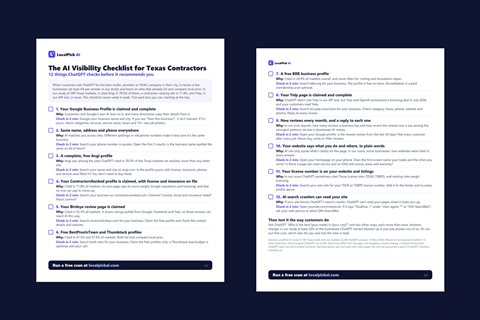
- Fix your listings on the sites ChatGPT cites. In our November 2026 study of 390 Texas markets, it cited Angi in 78.5% of markets and ContractorsRanked in 71.8%. See the directories ChatGPT reads and the "best of" sites.
- Keep reviews fresh. See how many reviews and how recent.
- Let the crawler in. See OAI-SearchBot.
- Check where you stand. See the five-minute test.
What your landing page needs
Whatever the channel, an ad only works if the page behind it earns the call:
- The service and the city in the first line, matching what the ad promised.
- A phone number that's visible without scrolling, answered by a person during the hours you state.
- Proof right on the page: license number, insurance, years in business, a few recent reviews with the service named.
- Plain pricing information: what affects the price, a realistic range if you're comfortable publishing one, and what a free estimate includes. See what to do when customers show you a ChatGPT estimate.
- A tracking method, such as a dedicated phone number or a "How did you hear about us?" question on every call.
Questions to ask any agency selling ChatGPT ads
- What's the monthly budget, and what's your fee on top of it?
- Can I see your results for a contractor in my trade and city (not a general case study)?
- How will you measure booked jobs, not clicks?
- Do I own the ad account and the data?
- What happens if it doesn't work, and can I cancel any month?
FAQ
Will running ads make ChatGPT recommend me in normal answers? We found nothing saying so. Ads are labeled and shown separately.
Is it too early to try? The platform is in beta and details may change. A small, capped test is a reasonable way to learn.
Can I do it myself? The reported self-serve platform is designed for that, but check the current requirements at OpenAI.
Know your organic starting point. Run a free scan at localpickai.com. You'll see whether ChatGPT names you without ads, who it names instead, which websites it read, and what to fix first. Free, no signup, about a minute.